User konikulin uploaded the image
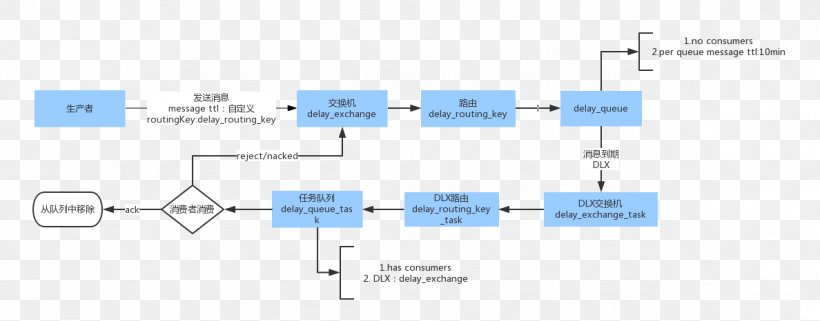
A flowchart that shows the process of sending a message to a customer. The flowchart is made up of several boxes connected by arrows, each box representing a step in the process. The first box on the left side of the flowchart has a message that reads "message ttl" and a description of the message. The second box has a description that says "delay-routing-key" and the third box has an explanation of the process, which explains how the message is sent to the customer. There are also two boxes on the right side of this flowchart, one labeled "delay_routing_key", which are used to communicate with the customer through the message and the other labeled "delay_exchange_task". The first box is used to send the message to the sender, while the second box is set to the receiver. The third box is also used to receive the message from the sender and the receiver, which is then sent to them by the sender. The fourth box is called "DUX", which means that the customer has received a DUX (DUX) exchange task. The fifth box is designated as "Dux", which is a type of DUX exchange task that allows the user to send and receive messages from their customer.
Quality Of Service Qcloud Spring Framework RabbitMQ Cloud Computing PNG
. The resolution of this PNG file is 1188 x 466 pixels and it has a file size of 45.25 KB.A flowchart that shows the process of sending a message to a customer. The flowchart is made up of several boxes connected by arrows, each box representing a step in the process. The first box on the left side of the flowchart has a message that reads "message ttl" and a description of the message. The second box has a description that says "delay-routing-key" and the third box has an explanation of the process, which explains how the message is sent to the customer. There are also two boxes on the right side of this flowchart, one labeled "delay_routing_key", which are used to communicate with the customer through the message and the other labeled "delay_exchange_task". The first box is used to send the message to the sender, while the second box is set to the receiver. The third box is also used to receive the message from the sender and the receiver, which is then sent to them by the sender. The fourth box is called "DUX", which means that the customer has received a DUX (DUX) exchange task. The fifth box is designated as "Dux", which is a type of DUX exchange task that allows the user to send and receive messages from their customer.
Quality Of Service Qcloud Spring Framework RabbitMQ Cloud Computing PNG
Related PNG Images